From back cover:
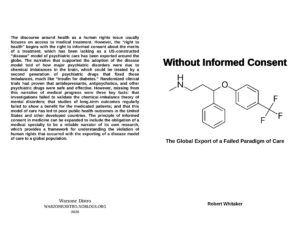
“The discourse around health as a human rights issue usually focuses on access to medical treatment. However, the “right to health” begins with the right to informed consent about the merits of a treatment, which has been lacking as a US-constructed “disease” model of psychiatric care has been exported around the globe. The narrative that supported the adoption of the disease model told of how major psychiatric disorders were due to chemical imbalances in the brain, which could be treated by a second generation of psychiatric drugs that fixed those imbalances, much like “insulin for diabetes.” Randomized clinical trials had proven that antidepressants, antipsychotics, and other psychiatric drugs were safe and effective. However, missing from this narrative of medical progress were three key facts: that investigations failed to validate the chemical-imbalance theory of mental disorders; that studies of long-term outcomes regularly failed to show a benefit for the medicated patients; and that this model of care has led to poor public health outcomes in the United States and other developed countries. The principle of informed consent in medicine can be expanded to include the obligation of a medical specialty to be a reliable narrator of its own research, which provides a framework for understanding the violation of human rights that occurred with the exporting of a disease model of care to a global population.”
Without Informed Consent_The Global Export of a Failed Paradigm of Care pdf
