An insurrectionary anarchist periodical which provides essays and clandestine actions, critical of leftism and formal organizing.

An insurrectionary anarchist periodical which provides essays and clandestine actions, critical of leftism and formal organizing.

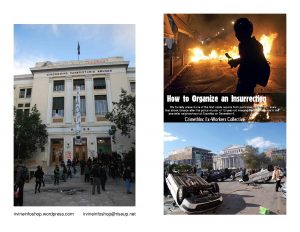
This (long awaited) zine contains a few action reports and a collection of essays written from a post-left anarchist perspective. Topics include insurrectionary anarchy, queer nihilism, veganism, individualism, nihilist anarchy and anti-civilization.

From back cover:
“Rebellion is the aggressive, dangerous, playful attack by freespirited individuals against society. Refusing a system of violence, refusing an organized, militarized form of armed struggle, allows the violence of insurgents to retain a high level of invisibility. It cannot be readily understood by the authorities and brought under their control. Its insurgent nature may even go undetected by the authorities as it eats away at the foundations of social control. From the rationalized perspective of authority, this playful violence will often appear utterly random, but actually is in harmony with the desires of the insurgent.”

This zine collects two excellent essays by Lawrence Jarach: “Leftism 101” from Back to Basics: The Problem of the Left put out by the Green Anarchy collective and “Anarchists, Don’t let the Left(overs) Ruin your Appetite” from Anarchy: A Journal of Desire Armed #48.
The first essay looks at the origins of Leftist thought and anarchism’s relationship to it. The second essay provides a brief overview of anarchists’ historical relationship with “the Left,” concluding that there is no point in engaging with it.

Text from the zine:
“No, our burned banks are not a way of protest or a token of friendship and solidarity with the “poor person” who does nothing and sits on his couch. It is a way to express our “I”. An “I”, that wants to stand out from the herd of slaves, an “I” that does not bow the head down, an “I” not waiting for the crowd to revolt, an “I”, which claims his own name, his own “acronym” and does not hide behind anonymity. The meeting time of the revolted ‘Egos’ takes up the name that we give to it. Its name is FAI and it is our “we”. A collective “we”, armed with razors against our enemies.”

From back cover:
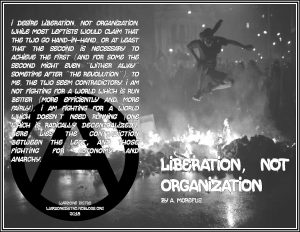
“I desire liberation , not organization. While most leftists would claim that the two go hand-in-hand , or at least that the second is necessary to achieve the first ( and for some the second might even “ wither away ” sometime after “ The Revolution ”), to me , the two seem contradictory. I am not fighting for a world which is run better ( more efficiently and more fairly ), I am fighting for a world which doesn’t need running ( one which is radically decentralized ) . Here lies the contradiction between the Left , and those fighting for autonomy and anarchy.”

Text from back cover:
“Every schoolchild in the U.S. has been taught that the Pilgrims of the Plymouth Colony invited the local Indians to a major harvest feast after surviving their first bitter year in New England. Here is the true story of that Thanksgiving. A story of murder and theft, of the first corporations invented on North American soil, of religious fundamentalism and relentless mania for money. It is a story of the birth of capitalism.”

From back cover:
“It is all those conspiratorial anarchists illegalists who made the anarchist insurrection their only home land. It is those who chose to stay away from the glory of the dead ideologies and bureaucracy of the social anarchism which awaits the masses in order to begin its insurrection. Lone and unique they armed their desires, put aside the pathetic rot of the mob and went on to the storming of heaven.
Their star fills our eyes, the fire floods our thoughts, the vendetta of revenge beats in our hearts and, our hands embrace the guns and dynamite which they inherited to us. We live for an endless explosion of actions, thoughts, feelings, desires, which reaches the edge of the world.
There is no nostalgia, there is only today, while tomorrow is already late. Today is our turn, our life, our time.”

From back cover:
“There are two types of cells, sleeper cells and phantom cells. The sleeper cell consists of one lone wolf individual; the phantom cell however is made of no more than 2-5 individuals. Anything beyond 5 members risks falling into the same pitfalls as the organization, and begins to lose its solidity and causes it to be more vulnerable to infiltration, thus compromising its effectiveness. More importantly, cell structure differs from the organization in that, if one cell is taken out and/or compromised, it remains physically impossible for that to have any effect on any other cell. If we drew one big circle or pyramid (the organization), imagine if it only took one pin to stick into the organization block to destroy it. In the case of cell structure, the only way to destroy the cells would be to pin them each one by one, which means you would need to first locate and identify each and every one, and pick them off individually. The chance of successfully identifying all of those unknown numbers of underground cells is usually quite small. This is what gives cell structured resistance its near invincibility.”
Lions in the Brush_On the Anatomy and Guidelines of Cell Structured Resistance pdf

From back cover:
“I have no need for the herd philosophy of the self-deceiving and self-sacrificing fantasy of communization and its inner leftism. I am opposed to its collectivist conformist cult of the worker, which dissolves the individual into the permanent roles of producer and consumer. When I work, I do so because I am forced and blackmailed to. So I refuse the slave role of “worker”. I want to see work abolished as a concept. I want to see the means of production and distribution reduced to ashes, blown up, turned down, destroyed and replaced with vast food forests and lush colorful gardens grown on top of the rubble.”
Max Stirner_Individualist Anarchy_ And a Critical Look at Egoist Communism pdf
The MOVE Organization was a radical movement that surfaced in Philadelphia during the early 1970’s. Characterized by dreadlock hair, the adopted surname “Africa”, a principled unity, back-to-nature green politics and an uncompromising commitment to freedom and equality, members practiced the teachings of MOVE founder JOHN AFRICA.
The MOVE Organization A Revolutionary Struggle for Black Liberation and Eco-Defense pdf
From back cover:
“After being expelled I rushed home to write this essay. I didn’t think, I just wrote. I wrote how I was feeling, what I was thinking. I was nothing but a pure-being of anger and hatred. Arguably, I still am, but for this essay to really make sense, you must know this information. It may seem like the ramblings of an angry teenager, and technically it is. However, this essay caused a ruckus. Shortly after the publishing of this essay, 15 ARMATARK Trucks, the company that supplies school lunches and prison lunches, were sabotaged. Their tires slashed, and bleach poured into their engines. No news reported this, other than a communique found around schools in Portland. Shortly after that, an entire condo complex was burned to the ground. This fire was the biggest fire seen in Portland, and everything was torched. A claim was made, by Students For Insurrection (SFI for short). They declared they would not stop, and they didn’t.”

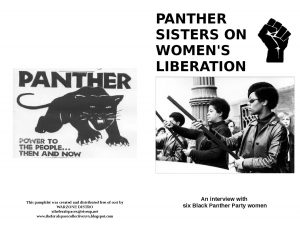
The following is an intensive interview with six Black Panther Party women about some of the issues raised by the women’s liberation movement and their own experience with women’s lib inside the Black Panther Party. The interview was conducted internally by the Panther Headquarters office and circulated as a four-page press leaflet.

Text from the zine:
“The following texts were translated and edited by the imprisoned members of the Conspiracy of Cells of Fire and by the comrades of Contra Info. We warmly thank them therefore, as well as the comrades A,M and E who contributed decisively in the handling of this attempt. Finally we greet the Chilean comrades from Entropia Ediciones for the version in Chile, and the comrades of Actforfreedomnow, boubour(A)s and 325 for the version in English.”
“They might have imprisoned our bodies but not our ideas, beliefs and values, which will continue to escape through various projects of insubordination. One of these projects is the creation of “Black International” editions, which are supported by us, the imprisoned members of the Anarchist Revolutionary Organization Conspiracy of Cells of Fire, and from certain comrades who every day, every moment, embody practically the value of SOLIDARITY.”
![]()
From back cover:
“But when we are condemned to hear socialists more or less theorizing in order to impudently and ignorantly state that there is no incompatibility between Individualist and collectivist ideas…when we hear someone try to make an invincible and unsurpassable iconoclast like Max Stirner out to be some tool for the use of frantic proponents of communism, then we may certainly have an ironic smirk on our lips. But then it is necessary to resolutely rise up to defend ourselves and to attack, since anyone who feels that he is truly individualist in principle, means and ends cannot tolerate being at all confused with the unconscious mobs of a morbid, bleating flock.”

Text from back cover:
“When Guy Debord of the Situationist International graffi tied the slogan “Never Work!” onto the walls of a Parisian street in 1953, he struck a blow in solidarity with the radical current of left communism which locates the wage-labour relation as the central pillar of capitalist relations and therefore the prime locus of attack. It is, of course, a banality that we need to work in order to produce for our basic needs. But what is at question here is the naure of that work, for whom, and to what end? Useful work? Or useless toil?”

From back cover:
“But this reality, however dismal, motivates my desire to make my life, through fierce revolt, as joyful and fulfilling as possible! My hopelessness does not paralyze me with fear or depression; I celebrate it with hysterical laughter and ecstasy in spite of civilization’s death march. I arm my desires with the urgency to live… against the social order of monotony and peaceful enslavement, to sleep beneath the stars, to feel sunshine and a breeze with every hair on my body, to listen to the late-night conversations of the insects, to become wild…

Text from back cover:
“The total liberation that I am speaking about could be nothing less than aggressive and in total conflict with the existent. The earth and the nonhuman animals as well as the human animals are parts of chaos. I am a nihilist and I see myself as an individuality inside the entire physical environment away from anthropocentric societies as the cities. Cities are prisons made by society and normality and must be torn down. Without the physical environment there would be no life. But without the cities there would still be life besides the changes this might involve that will occur, and i reject all views that state life is only viable within cities and civilization. So we should connect the struggle for liberation of our ego from every chain, with total liberation which goes beyond the destruction of the state and delves deep into the search of the destruction of anthropocentrism and civilization as two well hidden major ghosts, chains and ideologies.”

Text from the zine:
“The purpose of this paper is to help anarchist / anti-authoritarian movements active today to reconceptualise the history and theory of first-wave anarchism on the global level, and to reconsider its relevance to the continuing anarchist project. In order to truly understand the full complexity and interconnectedness of anarchism as a worldwide movement however, a specific focus on the uniqueness and agency of movements amongst the “people without history” is a deeply needed change. This is because the historiography of anarchism has focused almost entirely on these movements as they have pertained to the peoples of the West and the North, while movements amongst the peoples of the East and the South have been widely neglected. As a result, the appearance has been that anarchist movements have arisen primarily within the context of the more privileged countries. Ironically, the truth is that anarchism has primarily been a movement of the most exploited regions and peoples of the world. That most available anarchist literature does not tell this history speaks not to a necessarily malicious disregard of non-Western anarchist movements but rather to the fact that even in the context of radical publishing, centuries of engrained eurocentrism has not really been overcome. This has been changing to an extent however, as there here have been several attempts in just the past decade to re-examine this history in detail in specific non-Western countries and regions, with works such as Arif Dirlik’s Anarchism in the Chinese Revolution, Sam Mbah’s African Anarchism and Frank Fernandez’ Cuban Anarchism. It is within the footsteps of this recent tradition that this paper treads further into the relatively new ground of systematically assessing, comparing and synthesizing the findings of all of these studies combined with original investigation in order to develop a more wholly global understanding of anarchism and its history.”

Text from back cover:
“Feeling the need for revolt in their bodies, those of an individualist nihilistic bent never needed to justify their insurrection in terms of ‘the Will of the People’, ‘History’ or ‘Justice’; and have always been quite prepared to forego optimism in favour of honesty and pragmatism in favour of dignity. Amid the catastrophe of history, these individuals were free in the only way anyone can be free, by seizing their lives for themselves.”

From back cover:
““Their notion of “troubled joy” that they implicitly allude to in such roundabout ways, comes off sounding somewhat like a ruined orgasm (but not in a kinky way), cut short by thoughts of white guilt and internalized Christianity roaming the back of its head. This truncated notion of joy, though carefully detailed as to be allinclusive, is felt as if manicured to trim off any palpable trace of lust, wrath, or any of the remaining “deadly sins”. Though they reproduce criticism of a Catholic moralism that warns against excesses, one comes off with the impression that if ever playing “fuck, marry, kill” they would only ever choose “marry”, under the Church no less, lest anyone think they are of ill repute.
Perhaps they should have titled the book “Sad Militancy” since it deals mainly with that, as a problem. Not daring so much to propose much less embody a concrete way out of that impasse, while also seemingly still being held hostage by its affects. One wonders how they thought they could ever overcome “rigid radicalism”, while paralyzed by the rigor mortis of academia that was so palpable to me during my intercourse with this text.”

From back:
“They speak of collective power; no power can support itself without the voluntary servitude of those it dominates. Power is a social relationship, a social hierarchical organization model, a way of lifemanagement. Reformism acts on detail, quantitatively. It mobilizes vast numbers of people in order to change a few isolated aspects of power.
“Inhabit” is the sugarcoating of decentralized D.I.Y. biopolitics.
Security, territory, population. They encourage the reader to target an area with the logic of occupation.
Building hubs is an act of bordering, delimiting a zone of exclusion. An intimate act of social cohesion producing productive subjectivities, set apart from external superfluous strangers. The opposite of rewilding; recivilizing pockets of wildness…
…The time to attack is now.
There is nothing and no one to wait for. To act now, with determined projectuality where our
destructive tension is the defining factor in our lives, not something that is built upon by following a 9step program or a 5year plan.”

Text from back cover:
“It is selfevident that high school – as one of the institutions of capital – seeks to transform individuals into productive automatons. How it does this isn’t quite as clear. Sure, the same manipulative techniques are used as elsewhere in the spectacle, but what does this look like exactly and how does it feel? The high school student’s desire to explore and experiment with the world of knowledge – if it has survived years of previous schooling – is brutally perverted to serve the interests of industrial society. High school falsely satisfies this desire by offering a clockworklike sequence of curricular consumption and measured performance with the ostensible purpose of education and development.”

Text from back cover:
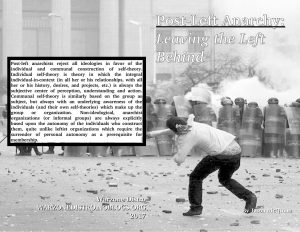
“Post-left anarchists reject all ideologies in favor of the individual and communal construction of self-theory. Individual self-theory is theory in which the integral individual in context (in all her or his relationships, with all her or his history, desires, and projects, etc.) is always the subjective center of perception, understanding and action. Communal self- theory is similarly based on the group as subject, but always with an underlying awareness of the individuals (and their own self-theories) which make up the group or organization. Non-ideological, anarchist organizations (or informal groups) are always explicitly based upon the autonomy of the individuals who construct them, quite unlike leftist organizations which require the surrender of personal autonomy as a prerequisite for membership.”

Text from the zine:
“Why has there been such a long history of conflict and enmity between anarchists and the left? It is because there are two fundamentally different visions of social change embodied in the range of their respective critiques and practices (although any particular group or movement always includes contradictory elements). At its simplest, anarchists especially anarchists who identify least with the left-commonly engage in a practice which refuses to set itself up as a political leadership apart from society, refuses the inevitable hierarchy and manipulation involved in building mass organizations, and refuses the hegemony of hand, has most commonly engaged in a substitutive, representational practice in which mass organizations are subjected to an elitist leadership of intellectual ideologues and opportunistic politicians. In this practice the party substitutes itself for the mass movement, and the party leadership substitutes itself for the party.”
“In reality, the primary function of the left has historically been to recuperate every social struggle capable of confronting capital and state directly, such that at best only an ersatz representation of victory has ever been achieved, always concealing the public secret of continuing capital accumulation, continuing wage-slavexy, and continuing hierarchical, statist politics as usual, but under an insubstantial rhetoric of resistance and revolution, freedom and social justice.”

From back cover:
“Love and support to those who dropped out of school and faced life with nothing more than a lockpick set and a backpack. Love and support to those who riot within the prisons of asylums and “correctional” facilities. Love and support to those who weaponized their lives, taking rebellion to their graves in choosing death over imprisonment. A howl to the lifestylist ex-workers who found fierce joy in the materialized anarchy of their wildest
dreams.”

Text from the zine:
“The omnipresence of cavities wherever the heinous putrefaction of Western Civ has reached has given rise to the dental profession. Dentistry is fucked up for too many reasons to list here. It has all the problems and inconsistencies inherent in every trade that requires intense specialization and professional schooling. Like every medical profession, it is disempowering in its attitude toward and treatment of the uneducated, the impoverished, and the unprofessional. It is unforgivably wasteful, and thrives on and upholds this throw-away culture. Also like every other medical profession, dentistry acts as a pimp to a whole catalog of nefarious industrial products manufactured by the big corporations that control the dental world.”

“The term “black” anarchist has been thrown around recently in a number of
international milieux and journals. Indeed during the last few years of my
travels throughout North and South America and Europe I have noted repeated
attempts to define, through action and theory, the ideas associated with black
anarchy. Following is a brief, incomplete outline of some of the more common
aspects of what black anarchists think and do. These tendencies are numbered
for convenience, and not to show priority or importance.”

In 1961, a young psychiatrist by the name of Thomas S. Szasz initiated a one-man insurgency against his own profession. After years of being a practicing psychiatrist, he became an outspoken dissident, hell-bent on dynamiting the foundations of psychiatry.
“Why is self-control, autonomy, such a threat to authority? Because the person who controls himself, who is his own master, has no need for an authority to be his master. This, then, renders authority unemployed. What is he to do if he cannot control others? To be sure, he could mind his own business. But this is a fatuous answer, for those who are satisfied to mind their own business do not aspire to become authorities.” -Thomas S. Szasz

Text from back cover:
“Just ‘cus people share the same institutionalized form(s) of oppression don’t automatically mean they share the same visions and objectives on how to destroy it. These are important differences that shouldn’t be flattened. While these groups continue their mind-numbing attempts to create a new system of race essentialism within the shell of the old, some of us are having fun destroying all the systems. My anarchy is an existential expansion of individuality beyond the limitations of racial (and gendered) social constructs.”
Really though, not all black people give a fuck about white dreads pdf

Text from back cover:
“As far as we know, we only have one life on this planet. Why should we waste it trying to adapt ourselves to the always more demanding expectations of this insane society when there is so much to live, explore, experience and discover? Changes always come from below and the old structures of oppression will inexorably fall when we stop relying on them.”

This zine highlights the history of the Deacons for Defense, an armed and determined group of black people in the heart of white supremacist terror.

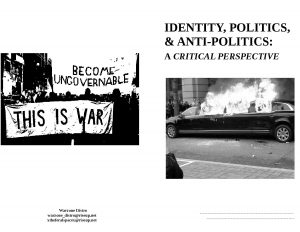
A collection of essays that thoroughly critique identity politics, ally politics and other forms of liberalism found in anarchist circles.

Text from back cover:
“Sabotage is thus an action that serves as a propellant against the unreality that oppresses us. A practice that has not gone unnoticed by ideological recuperation, which has transformed it into “terrorism” (the professionalization of sabotage that has done no more than reinforce the system, due to its centralist, hierarchical and militarist character). Today, what is proposed is not the creation of an armed organization of this type, but widespread attack by small affinity groups, uncontrollable by any higher organization, that come together and dissolve like the lunar tides. The tides that are born of the awareness of how bad things are and of the worsening that awaits us due to events.”

Text from back cover:
“People in relation to each other create healthy or unhealthy exchanges. There is no absolute for “fucked up,” “healed,” or “safe” it changes with time, life circumstance, and each new love affair. It is with feelings of unease that I have observed the slippery slope of “emotional” abuse become a common reason to initiate an accountability process…Here is the problem with using this model for emotional abuse: it’s an unhealthy dynamic between two people. So who gets to call it? Who gets to wield that power in the community? (And let’s all be honest that there is power in calling someone to an accountability process.) People in unhealthy relationships need a way to get out of them without it getting turned into a community judgement against whoever was unlucky enough to not realize a bad dynamic or call it abuse first…These processes frequently exacerbate mutually unhealthy power plays between hurt parties. People are encouraged to pick sides and yet no direct conflict brings these kinds of entanglements to any kind of resolve.”

From back cover:
“To negate the role of individual action in favour of a vague conception of the “class struggle” of yesteryear is a dangerous fiction. Certainly, since it is also the project of the State to destroy the volition and value of the individual; it cannot be called revolutionary, except in the autocratic uber-political sense of being ruled by statist apparatus – none of which desire empowered individuals or likeminded groups of individuals who want freedom.”
Powered by the ZenLite Black Mandarin Theme