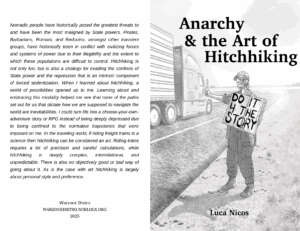
Anarchy & the Art of Hitchhiking


From back cover:

“Nomadic people have historically posed the greatest threats to and have been the most maligned by State powers. Pirates, Barbarians, Romani, and Bedouins, amongst other transient groups, have historically been in conflict with civilizing forces and systems of power due to their illegibility and the extent to which these populations are difficult to control. Hitchhiking is not only fun, but is also a strategy for evading the confines of State power and the repression that is an intrinsic component of forced sedentization. When I learned about hitchhiking, a world of possibilities opened up to me. Learning about and embracing this modality helped me see that none of the paths set out for us that dictate how we are supposed to navigate the world are inevitabilities. I could turn life into a choose-your-own-adventure story or RPG instead of being deeply depressed due to being confined to the normative trajectories that were imposed on me. In the traveling world, if riding freight trains is a science then hitchhiking can be considered an art. Riding trains requires a lot of precision and careful calculations, while hitchhiking is deeply complex, interrelational, and unpredictable. There is also no objectively good or bad way of going about it. As is the case with art hitchhiking is largely about personal style and preference.”

Anarchy & the Art of Hitchhiking pdf

Animal Colonialism in North America: Milk Colonialism, Environmental Racism and Indigenous Veganism


From back cover:

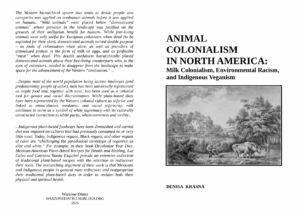
“The Western hierarchical system that tends to divide people into categories was applied on nonhuman animals before it was applied on humans. “Wild animals” were placed below “domesticated animals” whose presence in the landscape was justified on the grounds of their utilitarian benefit for humans. While free-living animals were only useful for European colonizers when dead (to be exploited for their skin), domesticated animals served double purpose – as tools of colonization when alive, as well as providers of animalized protein in the form of milk or eggs, and as profitable “meat” when dead. This double usefulness hierarchically placed domesticated animals above their free-living counterparts who, in the eyes of colonizers, needed to disappear from the landscape to make space for the advancement of the Western “civilization.” ……

Despite most of the world population being lactose intolerant (and predominantly people of color), milk has been universally represented as staple food and, together with meat, has been used as a colonial tool for gender and racial discrimination. While plant-based diets have been represented by the Western colonial culture as inferior and linked to emasculation, weakness, and racial inferiority, milk continues to serve as a symbol of white supremacy with its culturally constructed connection to white purity, whole-someness and virility……

Indigenous plant-based foodways have been diminished and carnist diet was imposed on cultures that had previously consumed no or very little meat. Today, Indigenous vegans, Black vegans, and other vegans of color are “challenging the paradoxical stereotype of veganism as elite and white.” For example, in their book Decolonize Your Diet: Mexican-American Plant-Based Recipes for Health and Healing, Luz Calvo and Catrióna Rueda Esquibel provide an extensive collection of traditional plant-based recipes with the intention to rediscover their roots. The overarching argument of their work is that Mexicans and Indigenous people in general must rediscover and reappropriate their traditional plant-based diets in order to reclaim both their physical and spiritual health.”

Animal_Colonialism_in_North_America pdf
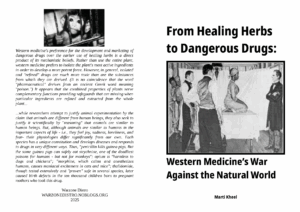
From Healing Herbs to Dangerous Drugs: Western Medicine’s War on the Natural World


From back cover:

“Western medicine’s preference for the development and marketing of dangerous drugs over the earlier use of healing herbs is a direct product of its mechanistic beliefs. Rather than use the entire plant, western medicine prefers to isolate the plant’s most active ingredients in order to develop a more potent force. However, in general, isolated and “refined” drugs are much more toxic than are the substances from which they are derived. (It is no coincidence that the word “pharmaceutical” derives from an ancient Greek word meaning “poison.”) It appears that the combined properties of plants serve complementary functions providing safeguards that are missing when particular ingredients are refined and extracted from the whole plant…

…while researchers attempt to justify animal experimentation by the claim that animals are different from human beings, they also seek to justify it scientifically by “reasoning” that animals are similar to human beings. But, although animals are similar to humans in the important aspects of life – i.e., they feel joy, sadness, loneliness, and fear- their physiologies differ significantly from our own. Each species has a unique constitution and develops diseases and responds to drugs in very different ways. Thus, “penicillin kills guinea pigs. But the same guinea pigs can safely eat strychnine, one of the deadliest poisons for humans – but not for monkeys”; opium is “harmless to dogs and chickens”; “morphine, which calms and anesthetizes humans, causes maniacal excitement in cats and mice”; thalidomide, though tested extensively and “proven” safe in several species, later caused birth defects in the ten thousand children born to pregnant mothers who took this drug.”

From_Healing_Herbs_to_Dangerous_Drugs pdf

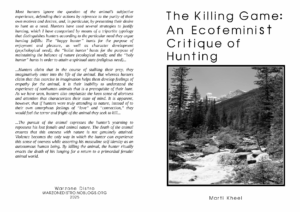
The Killing Game: An Ecofeminist Critique of Hunting

From back cover:

“Most hunters ignore the question of the animal’s subjective experience, defending their actions by reference to the purity of their own motives and desires, and, in particular, by presenting their desire to hunt as a need. Hunters have used several strategies to justify hunting, which I have categorized by means of a tripartite typology that distinguishes hunters according to the particular need they argue hunting fulfills: The “happy hunter” hunts for the purpose of enjoyment and pleasure, as well as character development (psychological need); the “holist hunter’ hunts for the purpose of maintaining the balance of nature (ecological need); and the “holy hunter” hunts in order to attain a spiritual state (religious need)…

…Hunters claim that in the course of stalking their prey, they imaginatively enter into the life of the animal. But whereas hunters claim that this exercise in imagination helps them develop feelings of empathy for the animal, it is their inability to understand the experience of nonhuman animals that is a prerequisite of their hunt. As we have seen, hunters also emphasize the keen sense of alertness and attention that characterizes their state of mind. It is apparent, however, that if hunters were truly attending to nature, instead of to their own amorphous feelings of “love” and “connection,” they would feel the terror and fright of the animal they seek to kill…

…The pursuit of the animal expresses the hunter’s yearning to repossess his lost female and animal nature. The death of the animal ensures that this oneness with nature is not genuinely attained. Violence becomes the only way in which the hunter can experience this sense of oneness while asserting his masculine self-identity as an autonomous human being. By killing the animal, the hunter ritually enacts the death of his longing for a return to a primordial female/animal world.”

The Killing Game_An Ecofeminist Critique of Hunting pdf

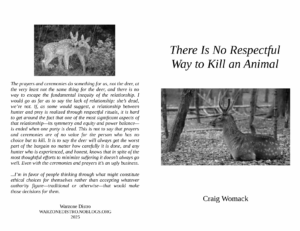
There Is No Respectful Way to Kill an Animal


From back cover:

“The prayers and ceremonies do something for us, not the deer, at the very least not the same thing for the deer, and there is no way to escape the fundamental inequity of the relationship. I would go as far as to say the lack of relationship: she’s dead, we’re not. If, as some would suggest, a relationship between hunter and prey is realized through respectful rituals, it is hard to get around the fact that one of the most significant aspects of that relationship—its symmetry and equity and power balance— is ended when one party is dead. This is not to say that prayers and ceremonies are of no value for the person who has no choice but to kill. It is to say the deer will always get the worst part of the bargain no matter how carefully it is done, and any hunter who is experienced, and honest, knows that in spite of the most thoughtful efforts to minimize suffering it doesn’t always go well. Even with the ceremonies and prayers it’s an ugly business.

…I’m in favor of people thinking through what might constitute ethical choices for themselves rather than accepting whatever authority figure—traditional or otherwise—that would make those decisions for them.”

There Is No Respectful Way to Kill an Animal pdf

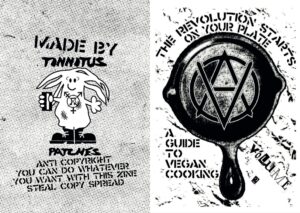
The Revolution Starts on Your Plate_A Guide to Vegan Cooking Volume 1-2

”The reason we provide this zine is to make clear that the vegan diet is more than just a diet; it’s an integeral part of a revolutionary lifestyle. Because not boycotting the bio-industry negates all points of total liberation. No one is free until all are free, which includes animals as well.

We hope to give you some knowledge how to make good vegan food without paying the highest price or supporting genocide.

Until every cage is empty”

– Tinnitus Patches XVX (Netherlands)

The Revolution Starts on Your Plate_A Guide to Vegan Cooking pdf

The Revolution Starts on Your Plate_A Guide to Vegan Cooking Vol. 2 pdf


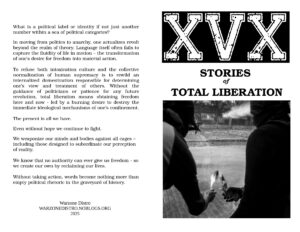
Stories of Total Liberation (A collection of personal stories written by vegan, straight edge anarchists)


From back cover:

What is a political label or identity if not just another number within a sea of political categories?

In moving from politics to anarchy, one actualizes revolt beyond the realm of theory. Language itself often fails to capture the fluidity of life in motion – the transformation of one’s desire for freedom into material action.

To refuse both intoxication culture and the collective normalization of human supremacy is to rewild an internalized domestication responsible for determining one’s view and treatment of others. Without the guidance of politicians or patience for any future revolution, total liberation means obtaining freedom here and now – led by a burning desire to destroy the immediate ideological mechanisms of one’s confinement.

The present is all we have.

Even without hope we continue to fight.

We weaponize our minds and bodies against all cages – including those designed to subordinate our perception of reality.

We know that no authority can ever give us freedom – so we create our own by reclaiming our lives.

Without taking action, words become nothing more than empty political rhetoric in the graveyard of history.

Stories of Total Liberation pdf