Medicine Goes to School: Teachers as Sickness Brokers for ADHD


From back cover:

“The role of the teacher as the sickness and treatment broker for ADHD has been elaborated more clearly for ADHD than for any other childhood disorder. The DSM-IV diagnostic criteria accord teachers a formal role in diagnosis through specialised assessment instruments such as the Conners Teacher’s Rating Scale. Teachers often agree to administer psychostimulant medication during the school day, although there is in Australia, the UK, and the US no legal compulsion to do so. A subtle incentive for teachers to administer medication in the middle of the day may be the assurance of a tractable child in the afternoon.

An informal role also exists for teachers as “disease-spotters.” There appears to be considerable difference internationally in the alacrity with which teachers engage in disease-spotting. In a study of 491 physicians in Washington, D. C., almost half of the diagnoses of ADHD in their patients had been suggested first by teachers. In the UK, on the other hand, parental concerns that a child has ADHD may be discounted by teachers.

Medicine Goes To School pdf

Without Informed Consent: The Global Export of a Failed Paradigm of Care


From back cover:

“The discourse around health as a human rights issue usually focuses on access to medical treatment. However, the “right to health” begins with the right to informed consent about the merits of a treatment, which has been lacking as a US-constructed “disease” model of psychiatric care has been exported around the globe. The narrative that supported the adoption of the disease model told of how major psychiatric disorders were due to chemical imbalances in the brain, which could be treated by a second generation of psychiatric drugs that fixed those imbalances, much like “insulin for diabetes.” Randomized clinical trials had proven that antidepressants, antipsychotics, and other psychiatric drugs were safe and effective. However, missing from this narrative of medical progress were three key facts: that investigations failed to validate the chemical-imbalance theory of mental disorders; that studies of long-term outcomes regularly failed to show a benefit for the medicated patients; and that this model of care has led to poor public health outcomes in the United States and other developed countries. The principle of informed consent in medicine can be expanded to include the obligation of a medical specialty to be a reliable narrator of its own research, which provides a framework for understanding the violation of human rights that occurred with the exporting of a disease model of care to a global population.”

Without Informed Consent_The Global Export of a Failed Paradigm of Care pdf

There Is No Such Thing as a Psychiatric Disorder/Disease/ Chemical Imbalance


From back cover:

“In 1948, “neuropsychiatry” was divided into “neurology,” dealing with diseases, and “psychiatry,” dealing with emotions and behaviors. If there is a macroscopic, microscopic, or chemical abnormality, a disease is present. Nowhere in the brains or bodies of children said to have ADHD or any other psychiatric diagnosis has a disorder/disease been confirmed. Psychiatric drugs appeared in the 1950s. Psychiatry and the pharmaceutical industry authored the “chemical imbalance” market strategy: they would call all things psychological “chemical imbalances” needing “chemical balancers” —pills.”

There Is No Such Thing as a Psychiatric Disorder_Disease_or_Chemical Imbalance pdf

Disorderly Conduct: Veganism, Eating Disorders, and Captivity

From back cover:

“The eating disorder recovery industry is a potent example of how human supremacy perpetuates harm and immense suffering. Have you ever heard anyone say they cannot be vegan because they are in recovery from an eating disorder? It is a common refrain foisted upon us by practitioners and institutions that force their subjects to view individuals with vastly different morphologies as commodities rather than as individuals who an alienating and oppressive global food system has likewise harmed. The recovery narrative itself is a fantasy when it is seemingly impossible to escape a context of imposed power that tries to force us into becoming as small, manageable, and legible as possible by prescribing rigid identities and modalities. Rather than viewing them as neutral sources of food, we should develop compassion for and solidarity with the animals who, like ourselves, are repeatedly abused by profit-driven food systems and psychiatric institutions that only serve the interests of those who hold power.”

Disorderly Conduct_Veganism, Eating Disorders, and Captivity pdf

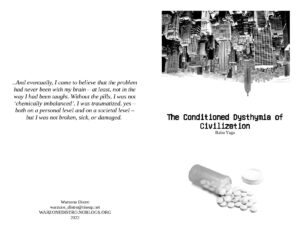
The Conditioned Dysthymia of Civilization

From back cover:

“…And eventually, I came to believe that the problem had never been with my brain – at least, not in the way I had been taught. Without the pills, I was not ‘chemically imbalanced’. I was traumatized, yes – both on a personal level and on a societal level – but I was not broken, sick, or damaged.”

The Conditioned Dysthymia of Civilization pdf

On Self-Love and Gun Powder

From back cover:

“I remain an embodiment of insubordination, the fluidity of unbridled emotions, the nihilist poetry of a tsunami in flux. I do not sympathize with conforming to behavorial servitude in order to preserve the general peace of subordinating civility! Rather than pacify my outrage or silence my despair, I have put all of society’s shame­-on­-mes and peer pressures to rest in coffins lined up for a bonfire in my head. And during their incineration, I will look up to the stars with a smile of admiration, for they are a dazzling beauty beyond the reach of civilized governance.”

On Self-Love and Gun Powder pdf

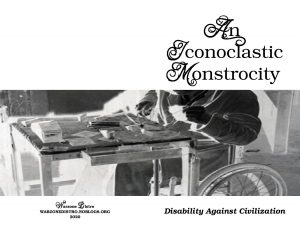
An Iconoclastic Monstrocity: Disability Against Civilization

Introduction:

“In the vast ocean of social war, some rebels – damaged, frail, or terminally ill – refuse to surrender to the victimization of disability. The world-builders attempt to subdue them with peace-offerings of technospheric assimilation and consumerist comforts. But these rebels – these monsters – refuse anything less than a hostile, insubordinate revolt against the domesticating machine…

This zine compiles the voices of some of these rebels. Together in this zine, and individually in their daily lives, they conspire to challenge the victimizing and civilizing narrative of disability discourse, while also taking aim at civilization itself.”

An Iconoclastic Monstrocity_Disability Against Civilization pdf

Descending into Madness: An Anarchist-Nihilist Diary of Anti-Psychiatry

From back cover:

“Like all governments, presidents, and authority, psychiatry never gave me freedom. Assigned psychiatric labels didn’t help me – they only filled me with an internalized sense of victimhood and inferiority. Medication didn’t ‘cure’ or ‘fix’ me – only damaged me, numbing me to my own senses in order to create an emotional void between me and the fuckery of civilized life. So instead, with nihilist celebration I descend into madness, taking aim at social order and civilization. With armed animalism I realize now that there was nothing to fix ­ my natural contempt for domestication and social control reminds me that I was never ‘broken’ to begin with.”

Descending into Madness_An Anarchist-Nihilist Diary of Anti-Psychiatry pdf

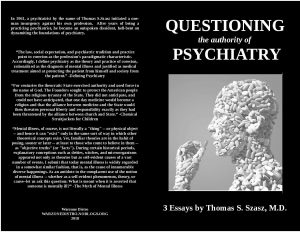
Questioning (the authority of) Psychiatry

In 1961, a young psychiatrist by the name of Thomas S. Szasz initiated a one-man insurgency against his own profession. After years of being a practicing psychiatrist, he became an outspoken dissident, hell-bent on dynamiting the foundations of psychiatry.

Why is self-control, autonomy, such a threat to authority? Because the person who controls himself, who is his own master, has no need for an authority to be his master. This, then, renders authority unemployed. What is he to do if he cannot control others? To be sure, he could mind his own business. But this is a fatuous answer, for those who are satisfied to mind their own business do not aspire to become authorities.” -Thomas S. Szasz

Questioning Psychiatry pdf

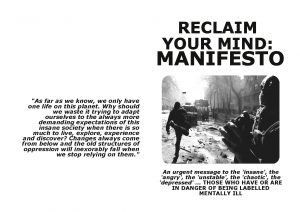
Reclaim Your Mind

Text from back cover:

“As far as we know, we only have one life on this planet. Why should we waste it trying to adapt ourselves to the always more demanding expectations of this insane society when there is so much to live, explore, experience and discover? Changes always come from below and the old structures of oppression will inexorably fall when we stop relying on them.”

Reclaim Your Mind pdf