Animal Colonialism in North America: Milk Colonialism, Environmental Racism and Indigenous Veganism


From back cover:

“The Western hierarchical system that tends to divide people into categories was applied on nonhuman animals before it was applied on humans. “Wild animals” were placed below “domesticated animals” whose presence in the landscape was justified on the grounds of their utilitarian benefit for humans. While free-living animals were only useful for European colonizers when dead (to be exploited for their skin), domesticated animals served double purpose – as tools of colonization when alive, as well as providers of animalized protein in the form of milk or eggs, and as profitable “meat” when dead. This double usefulness hierarchically placed domesticated animals above their free-living counterparts who, in the eyes of colonizers, needed to disappear from the landscape to make space for the advancement of the Western “civilization.” ……

Despite most of the world population being lactose intolerant (and predominantly people of color), milk has been universally represented as staple food and, together with meat, has been used as a colonial tool for gender and racial discrimination. While plant-based diets have been represented by the Western colonial culture as inferior and linked to emasculation, weakness, and racial inferiority, milk continues to serve as a symbol of white supremacy with its culturally constructed connection to white purity, whole-someness and virility……

Indigenous plant-based foodways have been diminished and carnist diet was imposed on cultures that had previously consumed no or very little meat. Today, Indigenous vegans, Black vegans, and other vegans of color are “challenging the paradoxical stereotype of veganism as elite and white.” For example, in their book Decolonize Your Diet: Mexican-American Plant-Based Recipes for Health and Healing, Luz Calvo and Catrióna Rueda Esquibel provide an extensive collection of traditional plant-based recipes with the intention to rediscover their roots. The overarching argument of their work is that Mexicans and Indigenous people in general must rediscover and reappropriate their traditional plant-based diets in order to reclaim both their physical and spiritual health.”

Animal_Colonialism_in_North_America pdf

From Healing Herbs to Dangerous Drugs: Western Medicine’s War on the Natural World


From back cover:

“Western medicine’s preference for the development and marketing of dangerous drugs over the earlier use of healing herbs is a direct product of its mechanistic beliefs. Rather than use the entire plant, western medicine prefers to isolate the plant’s most active ingredients in order to develop a more potent force. However, in general, isolated and “refined” drugs are much more toxic than are the substances from which they are derived. (It is no coincidence that the word “pharmaceutical” derives from an ancient Greek word meaning “poison.”) It appears that the combined properties of plants serve complementary functions providing safeguards that are missing when particular ingredients are refined and extracted from the whole plant…

…while researchers attempt to justify animal experimentation by the claim that animals are different from human beings, they also seek to justify it scientifically by “reasoning” that animals are similar to human beings. But, although animals are similar to humans in the important aspects of life – i.e., they feel joy, sadness, loneliness, and fear- their physiologies differ significantly from our own. Each species has a unique constitution and develops diseases and responds to drugs in very different ways. Thus, “penicillin kills guinea pigs. But the same guinea pigs can safely eat strychnine, one of the deadliest poisons for humans – but not for monkeys”; opium is “harmless to dogs and chickens”; “morphine, which calms and anesthetizes humans, causes maniacal excitement in cats and mice”; thalidomide, though tested extensively and “proven” safe in several species, later caused birth defects in the ten thousand children born to pregnant mothers who took this drug.”

From_Healing_Herbs_to_Dangerous_Drugs pdf

Native Americans and Vegetarianism


From back cover:

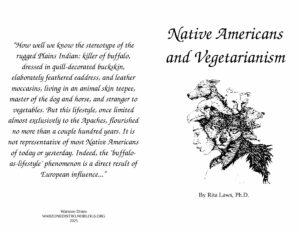
“How well we know the stereotype of the rugged Plains Indian: killer of buffalo, dressed in quill-decorated buckskin, elaborately feathered eaddress, and leather moccasins, living in an animal skin teepee, master of the dog and horse, and stranger to vegetables. But this lifestyle, once limited almost exclusively to the Apaches, flourished no more than a couple hundred years. It is not representative of most Native Americans of today or yesterday. Indeed, the “buffalo-as-lifestyle” phenomenon is a direct result of European influence…”

Native Americans and Vegetarianism pdf

The Killing Game: An Ecofeminist Critique of Hunting

From back cover:

“Most hunters ignore the question of the animal’s subjective experience, defending their actions by reference to the purity of their own motives and desires, and, in particular, by presenting their desire to hunt as a need. Hunters have used several strategies to justify hunting, which I have categorized by means of a tripartite typology that distinguishes hunters according to the particular need they argue hunting fulfills: The “happy hunter” hunts for the purpose of enjoyment and pleasure, as well as character development (psychological need); the “holist hunter’ hunts for the purpose of maintaining the balance of nature (ecological need); and the “holy hunter” hunts in order to attain a spiritual state (religious need)…

…Hunters claim that in the course of stalking their prey, they imaginatively enter into the life of the animal. But whereas hunters claim that this exercise in imagination helps them develop feelings of empathy for the animal, it is their inability to understand the experience of nonhuman animals that is a prerequisite of their hunt. As we have seen, hunters also emphasize the keen sense of alertness and attention that characterizes their state of mind. It is apparent, however, that if hunters were truly attending to nature, instead of to their own amorphous feelings of “love” and “connection,” they would feel the terror and fright of the animal they seek to kill…

…The pursuit of the animal expresses the hunter’s yearning to repossess his lost female and animal nature. The death of the animal ensures that this oneness with nature is not genuinely attained. Violence becomes the only way in which the hunter can experience this sense of oneness while asserting his masculine self-identity as an autonomous human being. By killing the animal, the hunter ritually enacts the death of his longing for a return to a primordial female/animal world.”

The Killing Game_An Ecofeminist Critique of Hunting pdf

There Is No Respectful Way to Kill an Animal


From back cover:

“The prayers and ceremonies do something for us, not the deer, at the very least not the same thing for the deer, and there is no way to escape the fundamental inequity of the relationship. I would go as far as to say the lack of relationship: she’s dead, we’re not. If, as some would suggest, a relationship between hunter and prey is realized through respectful rituals, it is hard to get around the fact that one of the most significant aspects of that relationship—its symmetry and equity and power balance— is ended when one party is dead. This is not to say that prayers and ceremonies are of no value for the person who has no choice but to kill. It is to say the deer will always get the worst part of the bargain no matter how carefully it is done, and any hunter who is experienced, and honest, knows that in spite of the most thoughtful efforts to minimize suffering it doesn’t always go well. Even with the ceremonies and prayers it’s an ugly business.

…I’m in favor of people thinking through what might constitute ethical choices for themselves rather than accepting whatever authority figure—traditional or otherwise—that would make those decisions for them.”

There Is No Respectful Way to Kill an Animal pdf

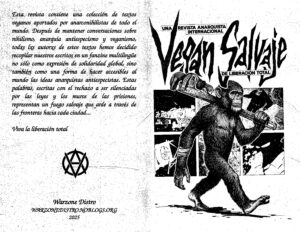
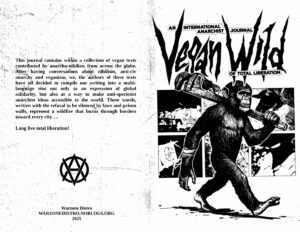
Vegan Wild: An International Anarchist Journal of Total Liberation (multi-language version), (Full Spanish version) & (Full English Version)

From back cover:

“Esta revista contiene una colección de textos veganos aportados por anarconihilistas de todo el mundo. Después de mantener conversaciones sobre nihilismo, anarquía antiespecismo y veganismo, todxs lxs autorxs de estos textos hemos decidido recopilar nuestros escritos en un fanzine multilingüe no sólo como expresión de solidaridad global, sino también como una forma de hacer accesibles al mundo las ideas anarquistas antiespecistas. Estas palabras, escritas con el rechazo a ser silenciadas por las leyes y los muros de las prisiones, representan un fuego salvaje que arde a través de las fronteras hacia cada ciudad…

Viva la liberación total”

(English translation)

This journal contains within a collection of vegan texts contributed by anarcho-nihilists from across the globe. After having conversations about nihilism, anti-civ anarchy and veganism, we, the authors of these texts have all decided to compile our writing into a multi-language zine not only as an expression of global solidarity, but also as a way to make anti-speciesist anarchist ideas accessible to the world. These words, written with the refusal to be silenced by laws and prison walls, represent a wildfire that burns through borders toward every city….

Long live total liberation!

Vegan Wild_An International Anarchist Journal of Total Liberation pdf

Vegan Salvaje español pdf

Vegan Wild_An International Anarchist Journal of Total Liberation_English Version pdf

Of Indigenous Hunters & Colonial Stereotypes: Indigenous Anarchy Against Hunting & Intoxication Culture

From back cover:

“In response to modern day hunters who call themselves “green” or “primitive” or “anti-civ anarchists”, they are an example of how humans are inherently violent, with each other and with other species, ether through war or terrorism, and they usually focus on the weaker. As for the animals, most of them don’t and can not defend themselves from the hunter. Hunting is a form of terrorism, that humans, past and present, attempt to justify as being “necessary” for survival reasons – grown men and women killing or beating the shit out of the innocent.”

Of Indigenous Hunters & Colonial Stereotypes_Indigenous Anarchy Against Hunting & Intoxication Culture pdf

Animal Bodies, Colonial Subjects: (Re)Locating Animality in Decolonial Thought

From back cover:

“I suggest that the recognition of animals as colonial subjects has been absent from Indigenous Studies. That is, contemporary decolonial thought has yet to engage with a politics of animality that not only recalls “traditional” and/or “ceremonial” human-animal relations, but is also accountable to animal subjectivities and futurities outside settler colonialism and within a project of decolonization. That is, decolonial thought cannot, for example, demand the repatriation of land as an ecofeminist praxis while simultaneously advocating for hunting as a recreational activity precisely because hunting has been weaponized as speciesism to normalize the killability of animals for human ends. Here, I propose a re-centering of animality through Indigenous cosmologies and epistemologies (specifically Mi’kmaq and Cree) to propose a decolonial animal ethic. […]

Several of the recommendations proposed by the animal liberation movement are thus applicable to decolonization. For example, rejecting animal experimentation, disrupting the commodification of animal bodies, and abolishing animal agriculture are gestures that can be deployed as anti-colonial gestures that reify decolonial futurities insofar as these forms of knowledge production, capitalism, and food culture sustain the settler state.[…]

…settler colonialism wants to produce animal bodies as commodities embedded in a global economy of reiterated deathliness. Said different, animal bodies that are inserted into capitalist spaces of commodity production are always already scheduled for death to be consumed as meat, clothing, scientific data, and so forth.[…]

Similar to the ways in which Indigenous peoples can undergo a violent process through which we rid our colonial mentalities, I argue that animals can be liberated from their colonized subjecthood through an aided “process of desubjectification”. That is, thinking through animality as an infrastructure of decolonization re-positions animal bodies as agents of anti-colonial resurgence.They can consequently engender “forms of energy that are capable of engaging the forces that keep [Indigenous people and animals] tied to [a] colonial mentality and reality”. Settler colonialism has therefore required the normalization of speciesism within Indigenous communities to obfuscate the radicality of Indigenous-animal relations. In that sense, recalling the representation of animals in Indigenous cosmologies/oral traditions and unsettling speciesism as a “colonial mentality” must be prioritized in decolonial thought.[…]

Animal Bodies, Colonial Subjects_(Re)Locating Animality in Decolonial Thought pdf
Veganism and Mi’kmaw Legends

From back cover:

“This text proposes a postcolonial ecofeminist reading of Mi’kmaw legends as the basis for a vegan diet rooted in Indigenous culture. I refer primarily to veganism throughout this work because unlike vegetarianism, it is not only a diet but a lifestyle that, for ethical reasons, eschews the use of animal products. Constructing an Indigenous veganism faces two significant barriers—the first being the association of veganism with whiteness…

…A second barrier to Indigenous veganism is the portrayal of veganism as a product of class privilege. Opponents claim that a vegan diet is an indulgence since the poor (among whom Indigenous people are disproportionately represented) must eat whatever is available, and cannot afford to be so picky. This argument assumes that highly processed specialty products make up the bulk of a vegan diet. Such an argument also overlooks the economic and environmental cost of meat, and assumes that the subsidized meat and dairy industries in North America are representative of the world.”

Veganism and Mi’kmaw Legends pdf

Veganism as Anti-Colonial Praxis: A Collection of Indigenous Vegan Perspectives

From back cover:

“Despite the absorption of veganism by the capitalist market – a process that admittingly reinforces pre-existing divisions across class and racial lines – a vegan lifestyle taken to its logical conclusion is fundamentally anti-capitalist and anti-colonial. By (re)acknowledging sentience and personalities within the bodies of colonized (animal) subjects, a vegan lifestyle rejects authoritarian relationships based on disrespect for the bodily autonomy of those whose lives have been re-purposed for human supremacist consumption.

This small collection of shared experiences, while reflective of a larger anti-colonial struggle, highlights the inclusion of an anti-speciesist, animal liberation.”

Veganism as Anti-Colonial Praxis_A Collection of Indigenous Vegan Perspectives pdf

Kaimangatanga: Māori Perspectives on Veganism and Plant-based Kai

From back cover:

““To adopt a form of veganism – a plant-based lifestyle and ethics – that acknowledges, is based upon, and celebrates Te Ao Māori, is a break from the dominant and from the status quo and but also an act of decolonialism. It is a way to reclaim sovereignty and exercise individual choice.

And finally, it is a means by which collective power and community may be built; this is evident in the existence of online forums and comment threads on Māori-based vegan and plant- based social media accounts.

Discussions regarding the intersections of vegan ethics, Indigeneity and Māoritanga and ideas about plant-based kai, and kaimangatanga are already occurring within Māori families and communities and the outcomes and possiblities that arise from this kōrero are potent and unique. There are karakia or prayers that refer to the sustenance provided by plant-based kai, and waiata (songs) which are based upon the care and protection of animal species and the environment. There are also resources and recipes for ‘veganizing’ traditional foods such as hangi (food cooked in the earth), and boil-up (a popular meat-based dish which usually includes plants such as pūha [sowthistle], potatoes, and watercress).”

Kaimangatanga_ Maori Perspectives on Veganism and Plant-based Kai pdf

Anti-Speciesism & Dietary Decolonization: A Short Introduction to Veganism

This zine breaks down the Standard American Diet, tracing it back to its colonial roots and advocates veganism as a form of anti-colonial resistance.

Anti-Speciesism Dietary Decolonization Intro to Veganism pdf

Colonialism, Imperialism & Animal Liberation

Text from the zine:

“Veganism, as an ethical choice, is thus a consistent complement to activism in the quest to end human domination over and exploitation of non-human animals. It transcends cultures, in the same way that other forms of oppression should be resisted no matter where they persist. All cultures are living and constantly evolving, and can from within their own cultural understanding find the tools and means through which speciesism, racism, sexism, capitalism or any other form of domination can be opposed. Everyone who opposes domination should find it within their interest to engage in or at least support the anti-speciesist struggle, for what more severe form of domination could we imagine than the notion that it is acceptable to harm and kill sentient beings because one likes their taste?”

Colonialism Imperialism and Animal Liberation pdf

Decolonizing the Diet: Towards an Indigenous Veganism

This zine contains a collection of essays and recipes focused on veganism as an indigenous form of anti-colonial resistance.

Decolonizing The Diet Towards an Indigenous Veganism pdf

My Vegan Straight Edge is Anything but White: An Indigenous Anarchist Critique of Speciesism and Intoxication Culture

Text from back cover:

“Aight, so I hear this and see this shit a lot. That vegans are  inherently white, that veganism is about consumerism, and it also makes the (racist) assumption that ALL POC have the same, monolithic culture around consuming and exploiting animals. The great hunter gatherer ideas are colonially based usually around the time where romanticism of indigenous ppl was the hip thing. Part of decolonization and rebalancing of our relation to the animal nations will need to involve us adjusting as we are at an ecological breaking point…”

“We can choose, and some of us do, to negate the existence of intoxicants for political and decolonial reasons. By refusing to play into not only what pacifies but what comes up and promotes systems that are inherently based in imperialism and capitalism as well as used to bolster kyriarchy all around, one feels all the agony they should: for themselves to do what they chose or must for existence without being lulled into any false pleasure of this civilization, for other beings and the planet being destroyed near and far from them, and for the future as this continues. You cannot destroy your masters without going all the way.”

My Vegan Edge is Anything but White pdf

We Refuse To Be Invisible: Black and Brown Vegan Power

Text from the zine:

“The purpose of this pamphlet is to create a platform for black and brown radical vegans to illustrate their experiences which not only negate settler-colonial white supremacy, but also institutional and cultural speciesism. While this pamphlet can not include the words of every black and brown vegan anarchist/anti-authoritarian, it is considered a good starting point in creating much needed dialog on speciesism, white supremacy and anarchy/anti authoritarianism. Unfortunately, veganism is still predominately associated with the Westernized stereotype of a white, classist privileged diet – marginalizing low-income radical vegans of color.”

Black and Brown Vegan Power pdf