Animal Colonialism in North America: Milk Colonialism, Environmental Racism and Indigenous Veganism


From back cover:

“The Western hierarchical system that tends to divide people into categories was applied on nonhuman animals before it was applied on humans. “Wild animals” were placed below “domesticated animals” whose presence in the landscape was justified on the grounds of their utilitarian benefit for humans. While free-living animals were only useful for European colonizers when dead (to be exploited for their skin), domesticated animals served double purpose – as tools of colonization when alive, as well as providers of animalized protein in the form of milk or eggs, and as profitable “meat” when dead. This double usefulness hierarchically placed domesticated animals above their free-living counterparts who, in the eyes of colonizers, needed to disappear from the landscape to make space for the advancement of the Western “civilization.” ……

Despite most of the world population being lactose intolerant (and predominantly people of color), milk has been universally represented as staple food and, together with meat, has been used as a colonial tool for gender and racial discrimination. While plant-based diets have been represented by the Western colonial culture as inferior and linked to emasculation, weakness, and racial inferiority, milk continues to serve as a symbol of white supremacy with its culturally constructed connection to white purity, whole-someness and virility……

Indigenous plant-based foodways have been diminished and carnist diet was imposed on cultures that had previously consumed no or very little meat. Today, Indigenous vegans, Black vegans, and other vegans of color are “challenging the paradoxical stereotype of veganism as elite and white.” For example, in their book Decolonize Your Diet: Mexican-American Plant-Based Recipes for Health and Healing, Luz Calvo and Catrióna Rueda Esquibel provide an extensive collection of traditional plant-based recipes with the intention to rediscover their roots. The overarching argument of their work is that Mexicans and Indigenous people in general must rediscover and reappropriate their traditional plant-based diets in order to reclaim both their physical and spiritual health.”
Animal_Colonialism_in_North_America pdf

From Healing Herbs to Dangerous Drugs: Western Medicine’s War on the Natural World


From back cover:

“Western medicine’s preference for the development and marketing of dangerous drugs over the earlier use of healing herbs is a direct product of its mechanistic beliefs. Rather than use the entire plant, western medicine prefers to isolate the plant’s most active ingredients in order to develop a more potent force. However, in general, isolated and “refined” drugs are much more toxic than are the substances from which they are derived. (It is no coincidence that the word “pharmaceutical” derives from an ancient Greek word meaning “poison.”) It appears that the combined properties of plants serve complementary functions providing safeguards that are missing when particular ingredients are refined and extracted from the whole plant…

…while researchers attempt to justify animal experimentation by the claim that animals are different from human beings, they also seek to justify it scientifically by “reasoning” that animals are similar to human beings. But, although animals are similar to humans in the important aspects of life – i.e., they feel joy, sadness, loneliness, and fear- their physiologies differ significantly from our own. Each species has a unique constitution and develops diseases and responds to drugs in very different ways. Thus, “penicillin kills guinea pigs. But the same guinea pigs can safely eat strychnine, one of the deadliest poisons for humans – but not for monkeys”; opium is “harmless to dogs and chickens”; “morphine, which calms and anesthetizes humans, causes maniacal excitement in cats and mice”; thalidomide, though tested extensively and “proven” safe in several species, later caused birth defects in the ten thousand children born to pregnant mothers who took this drug.”

From_Healing_Herbs_to_Dangerous_Drugs pdf

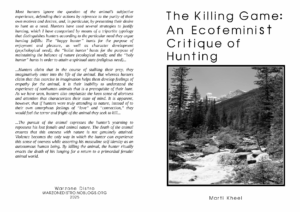
The Killing Game: An Ecofeminist Critique of Hunting

From back cover:

“Most hunters ignore the question of the animal’s subjective experience, defending their actions by reference to the purity of their own motives and desires, and, in particular, by presenting their desire to hunt as a need. Hunters have used several strategies to justify hunting, which I have categorized by means of a tripartite typology that distinguishes hunters according to the particular need they argue hunting fulfills: The “happy hunter” hunts for the purpose of enjoyment and pleasure, as well as character development (psychological need); the “holist hunter’ hunts for the purpose of maintaining the balance of nature (ecological need); and the “holy hunter” hunts in order to attain a spiritual state (religious need)…

…Hunters claim that in the course of stalking their prey, they imaginatively enter into the life of the animal. But whereas hunters claim that this exercise in imagination helps them develop feelings of empathy for the animal, it is their inability to understand the experience of nonhuman animals that is a prerequisite of their hunt. As we have seen, hunters also emphasize the keen sense of alertness and attention that characterizes their state of mind. It is apparent, however, that if hunters were truly attending to nature, instead of to their own amorphous feelings of “love” and “connection,” they would feel the terror and fright of the animal they seek to kill…

…The pursuit of the animal expresses the hunter’s yearning to repossess his lost female and animal nature. The death of the animal ensures that this oneness with nature is not genuinely attained. Violence becomes the only way in which the hunter can experience this sense of oneness while asserting his masculine self-identity as an autonomous human being. By killing the animal, the hunter ritually enacts the death of his longing for a return to a primordial female/animal world.”

The Killing Game_An Ecofeminist Critique of Hunting pdf

There Is No Respectful Way to Kill an Animal


From back cover:

“The prayers and ceremonies do something for us, not the deer, at the very least not the same thing for the deer, and there is no way to escape the fundamental inequity of the relationship. I would go as far as to say the lack of relationship: she’s dead, we’re not. If, as some would suggest, a relationship between hunter and prey is realized through respectful rituals, it is hard to get around the fact that one of the most significant aspects of that relationship—its symmetry and equity and power balance— is ended when one party is dead. This is not to say that prayers and ceremonies are of no value for the person who has no choice but to kill. It is to say the deer will always get the worst part of the bargain no matter how carefully it is done, and any hunter who is experienced, and honest, knows that in spite of the most thoughtful efforts to minimize suffering it doesn’t always go well. Even with the ceremonies and prayers it’s an ugly business.

…I’m in favor of people thinking through what might constitute ethical choices for themselves rather than accepting whatever authority figure—traditional or otherwise—that would make those decisions for them.”

There Is No Respectful Way to Kill an Animal pdf

Absurd, Disingenuous Rationalizations of Ranting Humancentric Anarchists

From back cover:

“Anti-civ anarchists attempting to ground their reasoning for hunting in primal human behavior are being self-contradictory. Surrendering one’s innate primal mutualism to anthropocentric supremacy grounded in moral and ethical ethos manifests in human incursions dominating and even killing other wild life. All wild animals live within a natural range, for example other great apes. They don’t naturally invade, conquer and colonize all of earth. Accepting civilization’s anthropocentric domination, as in hunting, is accomplished via indoctrinated moral conditioning, and is as much an authentic primal desire as that of a child to kill a rabbit and eat its raw tissues instead of picking and eating berries, mushrooms and nuts.”

Absurd, Disingenuous Rationalizations of Ranting Humancentric Anarchists pdf

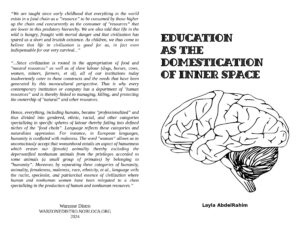
Education as the Domestication of Inner Space

From back cover:

“We are taught since early childhood that everything in the world exists in a food chain as a “resource” to be consumed by those higher up the chain and concurrently as the consumer of “resources” that are lower in this predatory hierarchy. We are also told that life in the wild is hungry, fraught with mortal danger and that civilization has spared us a short and brutish existence. As children, we thus come to believe that life in civilization is good for us, in fact even indispensable for our very survival…”

“…Since civilization is rooted in the appropriation of food and “natural resources” as well as of slave labour (dogs, horses, cows, women, miners, farmers, et al), all of our institutions today inadvertently cater to these constructs and the needs that have been generated by this monocultural perspective. That is why every contemporary institution or company has a department of “human resources” and is thereby linked to managing, killing, and protecting the ownership of “natural” and other resources.

Hence, everything, including humans, became “professionalized” and thus divided into gendered, ethnic, racial, and other categories specializing in specific spheres of labour thereby falling into defined niches of the “food chain”. Language reflects these categories and naturalizes oppression. For instance, in European languages, humanity is conflated with maleness. The word “woman” allows us to unconsciously accept that womanhood entails an aspect of humanness which erases our (female) animality thereby excluding the depersonified nonhuman animals from the privileges accorded to some animals (a small group of primates) by belonging to “humanity”. Moreover, by separating these categories of humanity, animality, femaleness, maleness, race, ethnicity, et al., language veils the racist, speciesist, and patriarchal essence of civilization where human and nonhuman women have been relegated to a class specializing in the production of human and nonhuman resources.”

Education As The Domestication of Inner Space pdf

AnPrim On Fire: Human Supremacy Within Anarcho­-Primitivist Narrative

From back cover:

“Early humans began as wild forest edge specialists who, through colonization with technologies as fire mastery, evolved into adaptive generalists, but not as one people in one instant. Civilization is not one event in time, but a tangle of invasive actions that converted lifeways and mindsets into supremacy, bewilderingly manifesting blatantly in those who strive for a way pre-­civ, or anti­-civ, or post­-civ. Tediously de­colonizing by pulling back the veils with an unblocked mind gets one nearer to sensing humans’ wild freedom. An anti­-colonizer finds the way of primal anarchy to be overt and/or covert smashing civilization with a cunning refusal to relent, while rewilding earth toward its pre­civ abundant flourishing.”

AnPrim on Fire_Human Supremacy Within Anarcho Primitivist Narrative pdf

Out of Civilitopia

From back cover:

“Why was caveman hunting selected for the podium, and not murder or rape or infanticide or cannibalism or causing species extinctions when there was also evidence of those in pre­history humans? When evidence of some hunting was found, why did that result in the practice of eating animals being applied to all humans going back to origins? Did the machismo leaders cherry pick a more alluring ‘killer ape’ early ancestry to justify current carnistic practices? Was it strategic that this lie also boosted the noxious ego to fuel the march toward the magical kingdom of Civilitopia?”

Out of Civilitopia pdf

Veganism is Anti-Speciesism is Anti-Civ

Text from zine:

“Contrary to the predatory man-the-hunter myth, hominids have innate empathy and cooperativeness that manifests idiosyncratically in civilization. One such manifestation is veganism, whose central focus is the abstention from needless exploitation of animals. But, conventional anarcho-primitivist pigeonholing of veganism into a consumerist schema has distorted its authentic essence, oversimplifying, distorting, and denouncing it. {Ironically, in practice it is the trending ‘paleo’ primitivist ideologues who engage in more destructive consumerism than even consumerist vegans, and of whom there is a void of conventional primitivist confrontation.} Veganism’s supporting principle is liberation of all animals, with its opposite being human supremacy over all other animals, or speciesism. Innate empathy and cooperation, combined with drive for liberation of all, beckons shifting the nature of humanimal-nonhumanimal relationships from domination and domestication to deferential and symbiotic. Therein veganism fundamentally becomes an anti-speciesist viewpoint concerned not only with bred ‘pet’ & ‘food’ animals and captive wildlife, but feral wildlife worldwide. This translates into vegan/anti-speciesist deeds like releasing imprisoned animals and protecting forests from consumeristic exploitation of fauna habitat.”

Vegan is Anti-speciesism is Anti-Civ pdf